@GeorgeSchlitz i think I might have been clinging to an old model of SCRAP in my mind. My model has been that of SCRAP being just a categorization of items within an organization’s processes. Nouns.
But what I am beginning to see is that SCRAP also includes lightweight but powerful tools for addressing SCRAP. Verbs.
The 3 step loop I see in your initial diagram conveys the verb aspect of SCRAP. I would like to see the nouns of SCRAP in the diagram with “A” highlighted somehow over the others as I believe all other aspects of SCRAP originate in an Assumption that must be tested.
SCRAP started as a bit of categorization back in the day. The things people kept running into took 1 of those forms.
Over time, these things happened:
(The noun?) What Organizational SCRAP is got much clearer. The categorization (which includes your “A” contribution among many other things) and understanding of SCRAP and its impact deepened a lot.
Better classification and patterns
Realization that de-emphasizing the categorization is critical in favor of becoming better at spotting, clarifying, making sense of, and prioritizing what to work on (OO in Boyd)…and thus…
(The verb?) Ways of dealing with SCRAP emerged - including
treatments (rework, eliminate, accept and the variants of those) how to work on SCRAP - which draw from manufacturing scrap concepts and other places) as well as
patterns of addressing specific kinds of SCRAP.
A point of view on change found its way in - but not a new model,
more of a basic adapter meant to be able to plug in any kind of change and continuous improvement stuff. How to continually sense and address SCRAP and how to expand that into broader, deeper change that sticks over time.
realization of how SCRAP gets protected by its army that has strategy and weapons
the idea of the pile being SCRAP that goes unaddressed and its impact being made more visible to all (this is what gives people of any level some influence)
Most importantly, the realization that SCRAP is about de-humanizing resistance and conflict. by providing a language and practices, we can objectively align on what SCRAP is and tackle it together, co-opting those that would otherwise be seen as “resistors”
A point of view on leadership was being established all the time - like with change, not a replacement for other leadership paradigms, but rather an augmentation of them.
Realization that the work of sensing and dealing with SCRAP is a missing responsibility of management (and in my opinion, one of the primary ones)
Most importantly, the realization that SCRAP provides language and practices that allow anyone of any level - manager or not - to have impact and take responsibility for change to some degree
I have toyed with literally using SCRAP verb too in different ways, but haven’t found anything that introduced more clarity than confusion yet. What are you thinking?
Re: “A” underneath the others - I also thought about doing that as I agree- there are assumptions underlying all the other kinds of SCRAP. And when I played with that I ran into some trouble in some common situations:
One of the most nasty kinds of SCRAP is the kind that is left behind from days past by people that are no longer around. Examples:
The process that is in place that no one will change or call out as problematic. Sometimes the assumptions behind it aren’t held by anyone- they are just doing what the docs say.
The unwritten rule that was inherited and is just part of the DNA of the organization. The people follow it just because “that’s the way things are done around here”
Nested SCRAP. The unwritten rule (we don’t collaborate with that other group) that’s based on assumptions (separate orgs and process means we need to communicate via docs) that are based on a structure (the org silos or separate processes).
Now we could go to each and eventually find the deepest assumptions, but in either case those assumptions either weren’t held by anyone (people left etc and the SCRAP lived on) or was so far removed from the people facing it that they would be going far beyond their purview. So there is really a short and long game, and both are needed.
Short game focuses on the SCRAP in front of me.
Long game focuses on the SCRAP underneath that which needs more work with more people to overcome.
I would love to see a diagram that includes People, Ideas, and Things, prioritized in that order. Don’t have People within the SCRAP loop as we don’t want to give the idea that we are SCRAPing on People, but rather People should be outside the loop orchestrating it. The Ideas could be the validations of Assumptions that are fed into the SCRAP engine/loop. The output from the SCRAP engine/loop would be something like what you already have in your diagram.
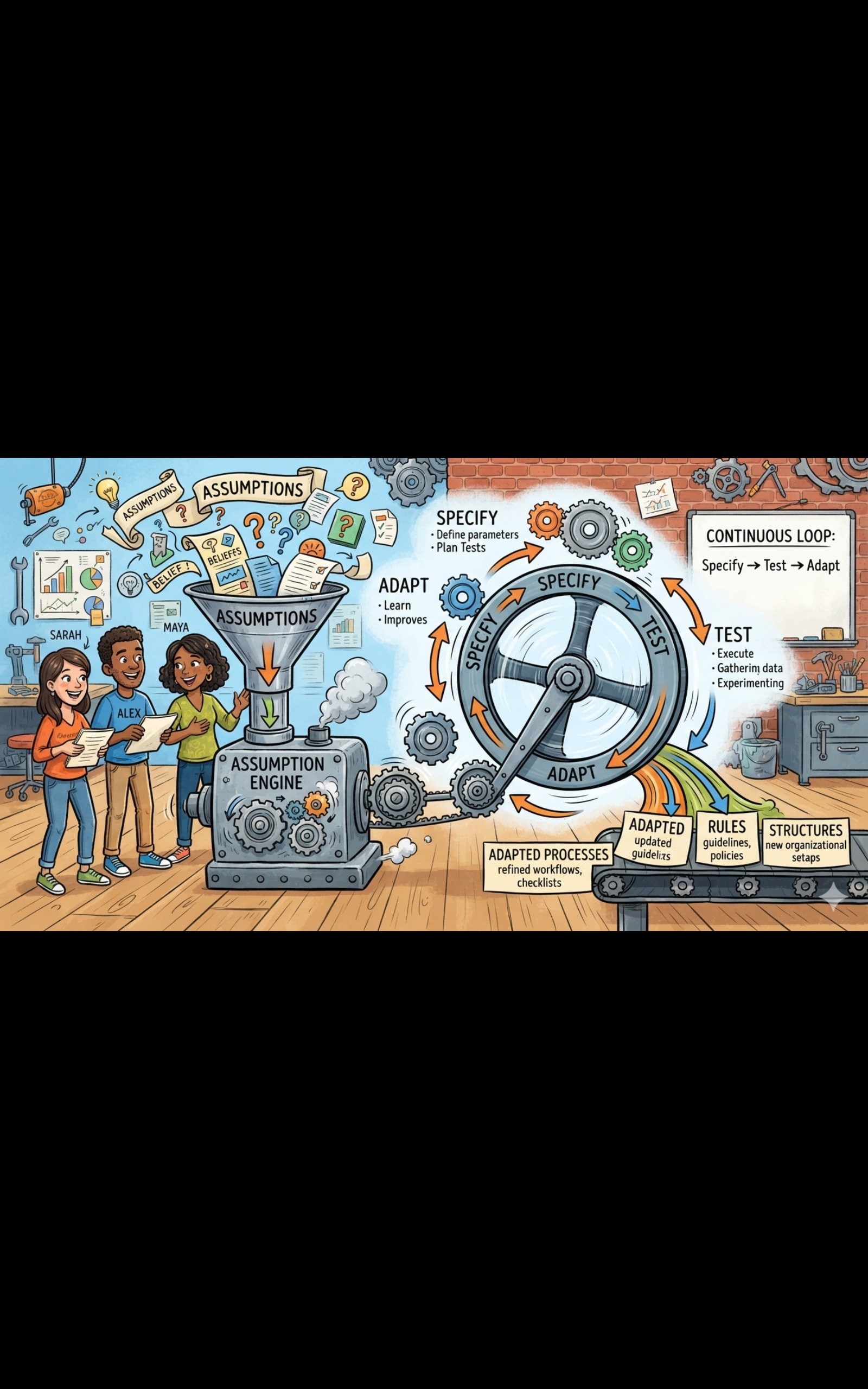
please draw a cartoon of 3 people feeding assumptions into a funnel that feeds the assumptions into an engine the drives a flywheel that is a loop of specify, test, and adapt and the output of the flywheel are adapted processes, rules, structures, or processes.
please draw a cartoon of 3 people feeding assumptions into a funnel that feeds the assumptions into an engine the drives a flywheel that is a loop of specify, test, and adapt and the output of the flywheel are adapted processes, rules, structures, or processes.
And this is the output it gave me. I’m not crazy about it but I’m putting it out here to facilitate further discussion:
@GeorgeSchlitz sorry I missed your earlier post about dormant/vestigial/legacy SCRAP. Something important to address. I have no conclusions or thoughts other than I’ve been kicking around Godel’s incomplete theorem. Is this type of SCRAP requiring someone outside of the system to recognize?